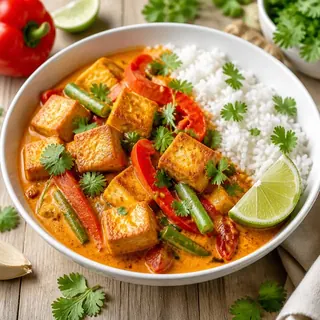
When coconut milk separates

Coconut milk is tiny oil droplets spread through water and held in place by proteins. Gentle heat leaves that structure intact, so the sauce stays smooth. Hard boiling or long reducing breaks it, and the oil leaks out in shiny pools.
Separate the cream on purpose
Many Thai recipes simmer the thick cream from the top of the can until its oil seeps out, then fry the curry paste in that oil. The separation is on purpose. The thinner milk goes in afterward, at a gentle simmer with small lazy bubbles.

Test yourself
Questions from the interactive lesson, with the answer and the why.
You boil a coconut curry hard for ten minutes and shiny oil pools on top. What happened?
The emulsion broke and the oil separated. Hard boiling weakens the protein hold, so the oil leaves the water.
True or false: Thick coconut cream separates into oil more readily than thin coconut milk when it is cooked.
True. More fat and less water means the emulsion breaks sooner, which Thai cooks use on purpose.
What went wrong? You pour coconut milk into a hot pan, crank the heat to a rolling boil, and walk away. The sauce turns grainy and greasy.
The hard boil broke the emulsion into curds and oil. Rolling heat pulls the proteins away from the fat.
Fill the blank: To keep coconut milk smooth, hold it at a gentle ___ with small, lazy bubbles.
To keep coconut milk smooth, hold it at a gentle simmer with small, lazy bubbles. Low, steady heat keeps the oil and water together.
You're reheating leftover coconut curry. What keeps the sauce smooth?
Warm it on low, stirring now and then. Gentle heat and stirring keep the oil and water together.